

Talent visas are a special breed. I write a lot about visas here and over on Relocate.me, and lately, whenever I’m writing a guide like this one or talking to professionals in the recruiting space, I get a renewed sense of optimism.
To put things into perspective, I’ll give you a swift rundown of how the market’s going in 2026. You should know that getting a job that relocates you, sponsors your visa, and pays for the move is harder than it was in 2021. It reflects the wider shift in software engineering: the hiring frenzy that followed the pandemic, when nearly every company was racing to build digital products, has cooled off. I said as much in my forecast for 2026, and again in the piece on how to write a cover letter, where one engineer wrote his letter and waited six months for the interview. That’s the pace of the market today.
But that’s part of why I’m optimistic. That’s mostly how one path, getting a job with relocation, holds today. But how about other paths, like using a talent visa to relocate and work abroad, without an employer sponsoring you? Because that’s what talent visas are for.
This is an update from a 2025 guide, and it leaves me with a feeling of opportunity. I added more countries than last time, and the list is curated: I did the research, I talked to people, I read the Reddit threads and the Facebook groups, and I kept only the ones I rate. So if you are set on leaving your country, consider this path alongside the classic one where a company pays your way, and keep it firmly in mind.
What a talent visa actually is (and exactly who it’s for) 🎫
In case you have never come across a talent visa, here is the difference with other visas. With a talent visa, you do not need a job already lined up for the country to grant it. You also do not need to show you are billing a set amount every month, which is what a digital nomad visa asks of you.
A talent visa is a different pitch. You are telling the country you want to take you in, that your ability and your past performance can give them something they would appreciate. You are talking about where your career sits, where you stand in the industry, what you have already done. Likewise, you are talking about how good you are.
I remember writing a guide like this a year or two back and noticing that, for a certain country, two groups come out ahead with these visas: performance artists and software engineers. That is still the reality of them! If you are reading The Global Move, I am going to guess you are the second kind.
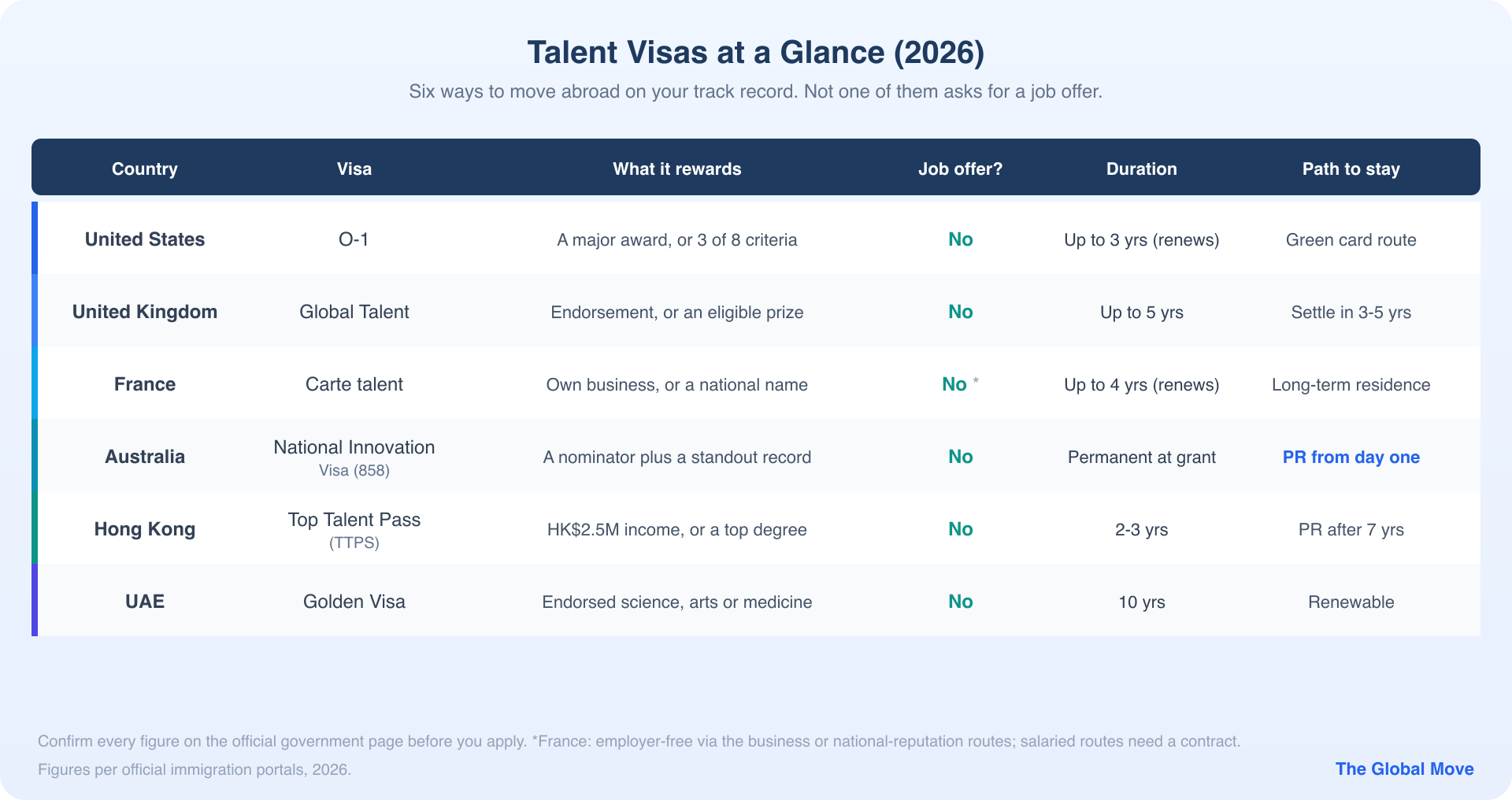
United States, the O-1 Visa 🇺🇸
According to Deel’s internal hiring data, which I broke down in my relocation-friendly jobs report, the O-1 is the most-used relocation visa for tech anywhere in the world, ranked number one ahead of the UAE, the Netherlands, and the rest. I hold that a little loosely, but it cuts both ways. The United States grants it, a country of roughly 330 million with a near-unmatched history of taking in talent from abroad, and it hunts for that talent in the best sense. The flip side is competition. The most requested visa is also the most contested.
The O-1 is the American talent visa, for people with “extraordinary ability.” You qualify with one major internationally recognized award, or by meeting at least three of the eight criteria:
published material about your work,
experience as a judge of others’ work,
original contributions,
authorship,
a high salary against your peers,
selective memberships,
awards, and
lead roles.
There is no cap and no lottery, unlike the H-1B, and it runs up to three years to start, with extensions. One point people get wrong: the O-1 has no self-petition. You need a US petitioner, though not a traditional employer. From what I found out in my research, it can be a US agent, which is how freelancers file, or a company you yourself own. I wrote a dedicated O-1 guide on all of it.
One piece of color. I know of two people who did their MBA in the United States in this newer political era, and both were already eyeing the O-1 as their way to stay. When people already working in the country treat it as their route to remain, the path clearly works, and the people deciding take it seriously. One caution I often repeat: do not focus only on the US. Remember that tech salaries in Switzerland run as high as American ones, a fact not many people know. Germany and France can offer a very high standard of living without a Silicon Valley paycheck. And The New York Times just ran a piece on San Francisco tech workers on $180k salaries struggling with the cost of living (I needed to rub my eyes when writing this! Imagine not making ends meet on $15k a month.) The O-1 is one door among many.
United Kingdom, the Global Talent Visa 🇬🇧
The UK Global Talent Visa is open to people in tech, academia, arts, and culture. The UK even hands these to musicians. You do not need a job offer. Most applicants first need an endorsement from an approved body that confirms you are the real thing, though if you have won an eligible award, you can skip that step and apply straight away.
Here is the update worth knowing because the previous version of this guide left it hanging. For the digital technology route, the endorsing body is once again Tech Nation. The organization wound down for a while, which caused a lot of “who signs off now?” confusion, but the Home Office handed the digital tech endorsement contract back to it in April 2025. (Still, it looks like the Tech Nation site was discontinued and you need to apply on the government’s official site.) The visa lets you stay up to five years at a time. If you come in as a well-known leader, you should settle in three years. If you come in as a promising leader, you should settle in five years.
France, the “Carte Talent” 🇫🇷
France renamed its program. What used to be the Passeport Talent is now the carte de séjour “talent,” or carte talent, after the 2024 immigration reform. It runs up to four years and renews, and your family can come with you on their own cards.
Be precise about which route fits, because this is where people trip. The genuinely no-employer routes are two: the “porteur de projet” card, where you found or run your own business, and the “renommée nationale ou internationale” card, for people with a real name in their field. The other talent routes, the salaried and Blue Card ones, need a French contract, so they are a different sort of thing. I was watching the NBA finals in June, and it struck me again that the most extraordinarily skilled and talented basketball player in the world is French. So my advice is this: do not apply to France on the strength of your jump shot. On the sports front, I do not rate your chances against that country. For everything else, it is one of the strongest options on this list.
Australia, the National Innovation Visa 🇦🇺
Australia is a genuinely sought-after place to land. Good weather in plenty of cities, a high standard of living, and software salaries that sit above some German pay rates. And there is a bedrock of established names to aim at, like Canva or Atlassian. It has long taken in qualified workers to fill its talent gaps, and engineers are squarely on that list. More Europeans move there for tech work than the other way around, and by some counts, a third of Australian tech workers speak a language other than English.
The talent route that needs no employer is the National Innovation Visa (subclass 858), and it grants permanent residency from the start, which puts it in a different weight class from most visas here. There is no points test. What there is instead is an invitation step: you file an expression of interest, the Department has to invite you before you can apply, and once invited you have 60 days to lodge. You also need a nominator with a national reputation in your field, an Australian citizen, permanent resident, eligible New Zealander, or an Australian organization, who signs your Form 1000. For tech people, the priority is called critical technologies.
I had a word with expats living in Australia, and I used their testimonies to compare against some online resources and share the following advice. The NIV, it seems, is a narrow door, kept for standout records. So most engineers reach Australia through its points-tested skilled routes, which are stricter: a degree, an English exam, and a points threshold that rewards experience most (the engineer I spoke with reached Australia with a different route altogether, which was an agreement between his university and the Australian government to give him a visa.) A software engineer with two years behind them can put in for the Skilled Independent Visa (subclass 189), though a stronger case wants three to eight years or more, and company sponsorship is the other way in.
Hong Kong, the Top Talent Pass Scheme 🇭🇰
I like putting options on this list that sit outside the usual European radius, and Hong Kong is a strong one. Its Top Talent Pass Scheme asks for no job offer at all. You qualify in one of two ways: a high income in the past year, around €280,000, or a degree from a top-ranked university, with the eligible list running to 200 institutions as of January 2026 (I love old school, 90s-like webpages like that one.) The top-income route now comes with a three-year visa, and seven years of continuous residence puts permanent residency on the table.
I will be candid about the limits of what I can tell you. I do not have a thorough read on how Hong Kong has shifted geopolitically over the last few years, so I am not going to crown it or write it off. What I can pass on, from people who have gone to work there, is that they land in a very strong expat community. You can build your hobbies, your friends, even your five-a-side football team out of people from almost everywhere: Asia, Europe, the Americas. On that basis alone, this is a very intriguing option in a very active, fast-moving city, and it is well worth a serious look.
United Arab Emirates, the Golden Visa 🇦🇪
The UAE Golden Visa has real talent routes that need no employer: scientists and researchers, creative talents, doctors, and top graduates, most of them on the ten-year card, each gated by an endorsement letter from the relevant authority rather than by a job. Some routes are also open to executives and skilled workers, but you need a job contract and a certain salary to qualify, so read carefully before you think you qualify!
When I researched the UAE for the digital nomad visas update, I ran into trouble just working out what they wanted. A page would not load, or the English version would crash. And the requirements were vague. They would tell you that you needed a degree from a top university and then not tell you which universities counted! So treat the UAE as a genuine opportunity, but go slowly, and confirm every requirement on the official ICP page before you count on anything.
A few more worth naming (Yes, 🇨🇦)
Three that do not get their own section but belong on your radar. Canada is loose pick here: it has no talent visa as such, but with a well-paying remote job and an EOR, you can move and work in North America legally. Singapore and its Overseas Networks & Expertise Pass deserve a mention for the same reason as Hong Kong. I always rate these very global, metropolitan hubs, and Singapore is one of the best of them. And the Chancenkarte, Germany’s Opportunity Card, is one of my favorite newer visas. It is a job-seeker one rather than a talent visa, so it lives in my Job Seeker Visas guide, but I wanted it here anyway because it is that good a route.
How to build the profile that gets you in
The visa is decided on what you can show, so grow the things you can show. Some items:
Go to industry conferences, and speak at them if you can.
Get published in places people respect.
Keep an active GitHub. I used to lean hard on the “green squares,” the record of daily contributions, and I am no longer sure how much weight they carry. Nobody looks at 45 pull requests in a single day and thinks, “Wow!” More likely they think, “this person really knows how to use Claude Code,” which is not the worst thing to signal in 2026 either.
My most repeated piece of advice for 2026 is to make your material short and genuinely well-crafted. I wrote up how to do exactly that. Remember, the person reading is buying something (they are buying talent.) So show them what they came to read, and show them you did your homework. And as you can learn throughout the piece on how to prepare for an overseas move, start connecting with the people in the decision well before you apply. Use LinkedIn properly, and find a compatriot who has already been through it and can tell you where the potholes are.
Is this path for you? Think about it twice!
Before dedicating yourself to it, remember that taking the talent path will take a lot of effort (I’m sorry, I don’t see any shortcuts coming up soon.) So think about it before committing to it!
… but still, don’t forget about all those paths!
But I’ll be a bit at odds here. Even if you lock in and say that the talent path is for you, please don’t write off all the other options. There are so many!
For example, I talked about the education path before. I know an engineer who entered the Netherlands with no visa, went through the whole process, and is now a Dutch citizen near Rotterdam with a house he owns, free to work anywhere in Europe. I interviewed him for my piece on relocating through the university path.
Companies change locations, too! Catawiki, out of the Netherlands, just opened a relocation policy to Portugal. Lock onto one country with no roles in it, and you are the one who draws the curtain.
Just keep your options on the waiting list.
Thanks for reading, and I would love to hear in the comments if you have been through something similar and found the thing that made the difference! Good luck 🤞
I publish relocation-friendly tech roles every week at The Global Move, and we’re building the Internet’s biggest community for software engineers who want to live and work abroad or score a genuinely remote job. If you’re getting ready for your move, subscribe and start building your platform now.
Well, well! I'm so glad you dug into the Tech Nation saga, because I'd heard it wound down and just assumed the whole Global Talent route was in limbo. Turns out it's alive again ... but just hiding behind the government site instead of its old home. Geez. Exactly the kind of detail that trips people up, right? Whoanelly. Imagine doing all that prep, only to apply through the wrong portal and stalling out for months. Bah I say. Thanks for writing this!
> Imagine not making ends meet on $15k a month.
This is not the point of the post, but just to be fair, about 1/3 of that will go into taxes depending on the marital status (a little less for married), and 10k is not that much when the rent alone is 3-4k.